
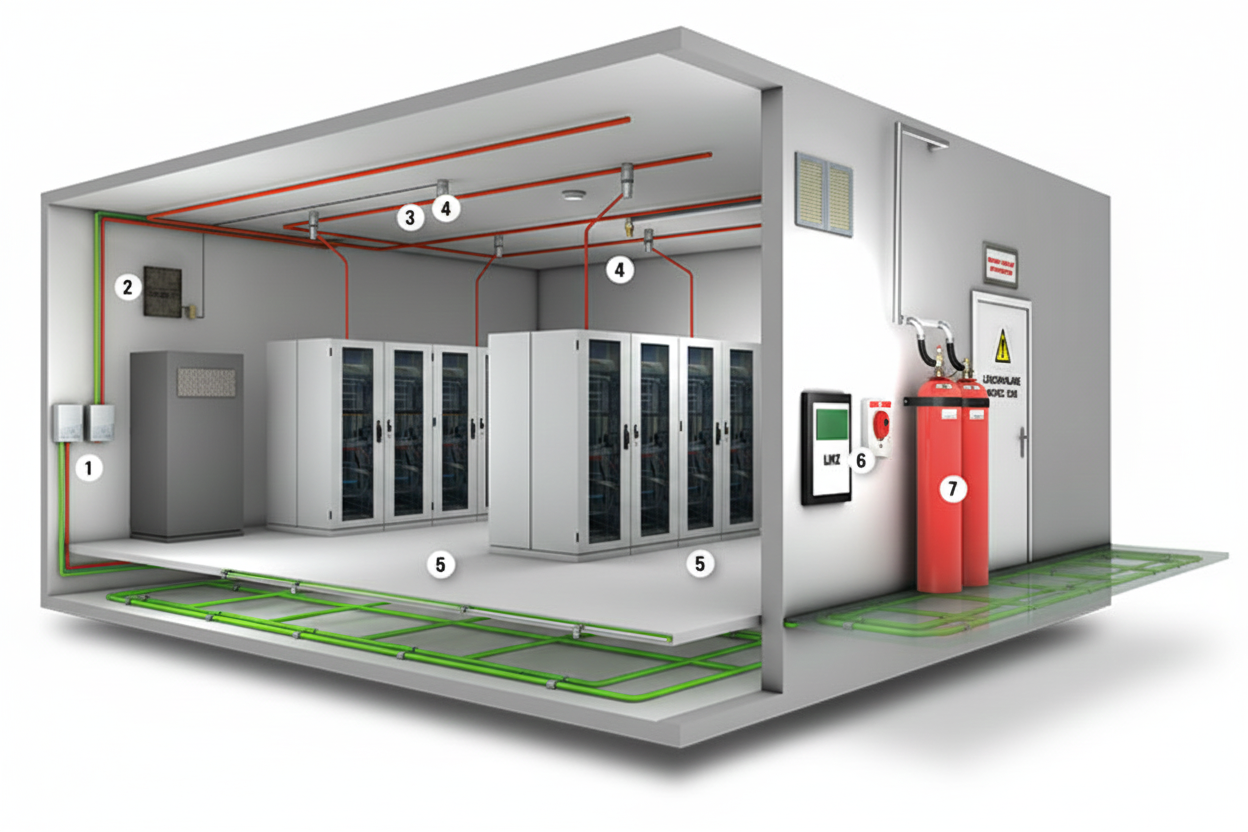
Server Room & Data Center Fire Protection: What Most Companies Miss Server Room & Data Center Fire Protection: What Most Companies Miss Data centers and server rooms are the backbone of today’s business ecosystem. They house everything that keeps a company alive: mission-critical applications, customer data, ERP systems, automation platforms, payment systems, cloud integrations, backups, compliance logs, and more. Basically, if the server room dies, the entire organization collapses like a badly wired UPS. And yet, fire protection for these spaces is one of the most overlooked safety measures in Indian businesses. Companies willingly spend crores on hardware but hesitate to invest a fraction of that in early-warning detection, clean agent suppression, or room integrity. This mindset is exactly what leads to catastrophic downtime, destroyed assets, and irreversible data loss. Server room fires don’t behave like normal fires. They are fast, electrical, and fueled by high-density heat loads. It only takes one overheating component, one faulty cable, or one overworked UPS battery to set off a chain reaction. Without proper fire protection, the consequences can escalate in minutes. This blog breaks down exactly what companies keep missing, why older fire systems don’t work for IT environments, and how advanced systems like VESDA, gas suppression, and clean agent fire protection are now non-negotiable for industries. Why Fire Protection in IT Spaces Is Different Data centers aren’t office cubicles with a couple of laptops. They’re high-value, high-risk spaces with unique hazards: High heat load from servers Dense electrical distribution Continuous power usage Raised flooring and hidden cabling Hot and cold aisle airflow UPS systems and battery banks that can fail catastrophically Even a small fire incident can cause: Multi-crore asset damage Service downtime Loss of critical data Regulatory non-compliance Customer loss and reputational damage IT industries, manufacturing units, BFSI, government departments, logistics companies, retail brands, healthcare facilities, and even MSMEs rely on uninterrupted data operations. One downtime event can cost lakhs to crores per hour. Yet surprisingly, many organizations still depend only on: Smoke detectors meant for office use Fire extinguishers that can’t be used on sensitive electronics Poor-quality cabling No real-time fire monitoring No early-warning detection No suppression system that protects electronics This mindset is exactly why fire incidents in server rooms keep happening. Let’s break down the core systems most companies miss. 1. VESDA Systems: The Early-Warning Heroes Most Companies Don’t Instal Most businesses still install office-grade smoke detectors in server rooms and walk away thinking they’re safe. But those detectors operate only after visible smoke reaches a high enough density to trigger them. By that time, the fire is already active. That’s exactly why VESDA (Very Early Smoke Detection Apparatus) exists. VESDA doesn’t “wait” for smoke. It actively pulls in air samples from all parts of the room using a high-sensitivity aspirating system. Inside the detector, laser analysis identifies microscopic smoke particles — the kind that appear when components start to overheat. Why VESDA is essential for IT environments Detects overheating before fire forms Can identify issues at the earliest incipient stage Suitable for high-airflow environments that fool normal detectors Extremely sensitive and customisable Integrates with suppression systems Dramatically reduces downtime A VESDA system can alert teams before anyone even smells burning plastic. It can prevent a smoking UPS from becoming a full-blown hazard. It gives companies time to act, isolate circuits, and shut down equipment gracefully. Why many companies skip VESDA They assume it’s too expensive They think standard smoke detectors are enough They don’t understand the real risks They underestimate how fast IT equipment can ignite But here’s the truth: One hour of downtime costs far more than a full VESDA installation. Ignoring VESDA is one of the biggest mistakes businesses make. 2. Gas Suppression Systems: The Only Safe Way to Extinguish IT Fires Let’s be blunt: water is amazing for office fires, but it will absolutely annihilate your servers. You can’t use sprinklers, water mist, or foam agents in a server room. Even portable CO₂ extinguishers can damage sensitive electronics and suck the oxygen out of the room, putting people at risk. That’s why data centers rely on gas suppression systems, also known as inert or clean agent flooding systems. These systems extinguish fire without: Water Residue Corrosion Equipment damage How gas suppression systems work Fire detection triggers the system. The room is flooded with gas from ceiling-mounted cylinders. The agent displaces oxygen or removes heat. Fire is suppressed within seconds. Equipment survives with zero residue. This is the cleanest, fastest, and safest way to protect mission-critical areas. Most-used gas suppression agents NOVEC 1230 (FK-5-1-12) FM-200 IG-55 (Argonite) IG-541 (Inergen) IG-100 (Nitrogen) CO₂ (not recommended for occupied spaces) Why gas suppression is critical Stops fire instantly No post-cleaning Zero damage to IT systems Works even if no one is present Prevents downtime and business interruption A few seconds can decide whether your servers stay alive or turn into scrap metal. Gas suppression gives you that window of protection. 3. Clean Agent Systems: The Modern Standard Clean agents are the next generation in fire suppression. They’re designed specifically for environments where: Equipment is sensitive Downtime is expensive Water is not an option Clean agents don’t damage electronics or leave chemical traces. They evaporate instantly after discharge. Why clean agents are the Gold Standard Safe for people Eco-friendly (especially NOVEC replacements) Fast-acting Zero residue No after-cleanup Ideal for enclosed rooms Compliant with global data center standards Clean agent systems suppress fire by: Absorbing heat Interrupting the chemical combustion reaction This stops the fire without affecting the integrity of the equipment. Perfect applications Server rooms NOCs Data centers UPS battery banks Network distribution rooms Control rooms in factories Companies that run 24/7 operations — manufacturing, BFSI, IT, telecom, and healthcare — depend heavily on clean agent systems to avoid downtime. What Companies Still Mess Up (Even After Installing Systems) Installing VESDA or gas suppression is only half the job. The other half is actually maintaining them. Here are the mistakes that keep happening: 1. No integration between detection

The Foundation of a Reliable IT Infrastructure: What Every BusinessShould Know
The Foundation of a Reliable IT Infrastructure: What Every Business Should Know The Foundation of a Reliable IT Infrastructure: What Every Business Should Know Every business today runs on technology, even the ones pretending they don’t. Whether it’s a factory floor full of sensors, a corporate office juggling thousands of emails per minute, or a logistics operation relying on real-time tracking, IT infrastructure quietly keeps everything moving. When it fails, work collapses. Orders stop. Employees get stuck. Customers get annoyed. And businesses lose money at a pace nobody wants to admit. That’s why a reliable IT infrastructure is not some optional tech upgrade. It’s the base layer that every modern company, from manufacturing plants to financial institutions, absolutely depends on. Building this foundation requires more than plugging in a few devices. It demands strategic planning across five core pillars: network design, redundancy, structured cabling, switching, and scalability. For industries and business decision-makers, understanding these pillars isn’t just tech knowledge. It’s knowing how to avoid downtime, future-proof operations, and make smarter IT investments. Let’s break down each area in a way that actually helps businesses take real decisions. 1. Network Design: The Digital Blueprint of Your Entire Company Network design is the architectural plan that decides how every device, server, system, and user in your company communicates. Think of it like creating roadways inside a city. If the roads are poorly planned, you get traffic jams, confusion, slow movement, and chaos. A properly designed network gives your business stability, speed, security, and the ability to grow without breaking things every six months. Why Good Network Design Matters for Industries For manufacturers, logistics companies, corporate offices, warehousing units, hospitals, and almost every modern business, network design influences: Efficiency of daily operations Quality of communication between teams Data security and breach prevention Smooth access to cloud applications Uptime of critical systems Ability to adopt automation, IoT, and digital platforms A poorly designed network doesn’t just slow people down. It becomes a bottleneck that holds the entire business hostage. Core Elements of a Strong Network Design a) Proper Segmentation Different departments have different traffic loads. Separating them using VLANs ensures no single team drains everyone else’s bandwidth. Example: A design team using heavy CAD files shouldn’t choke the HR department’s network. b) Logical IP Address Planning IT teams should not be wandering around like detectives trying to trace devices. Organised IP planning reduces troubleshooting time and makes management clean and efficient. c) Optimized Traffic Flow Traffic should take the shortest, least congested path. This becomes crucial in large offices, plants, or multi-building campuses where time-sensitive systems rely on uninterrupted communication. d) Security Layers Built In Firewalls, ACLs, intrusion prevention, and segmentation should be part of the design, not added later as a band-aid. e) Wi-Fi Coverage and Access Point Placement Industries often underestimate how many access points they need. Good network design ensures every corner of the workspace gets strong, stable connectivity. How Bad Network Design Hurts Businesses Frequent downtime or lag Slow performance during peak usage Increased cyber threats Lost productivity High troubleshooting costs Employees endlessly complaining about “slow internet” Strong network design is the first step in building a reliable infrastructure. But design alone isn’t enough. 2. Redundancy: The Only Real Backup Plan Businesses Can Trust Businesses love to talk about “99 percent uptime,” but what they forget is that uptime comes from redundancy, not optimism. Redundancy means having backup systems, paths, and power that instantly take over when something fails. Not after an hour, not after IT investigates. Immediately. Why Redundancy Is a Non-Negotiable for Industries Every sector today needs uninterrupted operations: Manufacturing plants rely on automated machines E-commerce platforms depend on real-time order processing BFSI companies handle sensitive financial data Hospitals work with life-critical systems Corporates need continuous communication If a router dies, a link drops, or power fails, businesses can’t afford to stop. Redundancy prevents these shutdowns. Types of Redundancy Businesses Need a) Network Redundancy Multiple connections ensure that if one line drops, another picks up instantly. This includes: Dual internet circuits Redundant routers Secondary links between switches Multiple paths for data traffic For industries with real-time operations, having a single link is basically asking for trouble. b) Hardware Redundancy One firewall should not be the single point of failure. Advanced setups use: Dual firewalls Dual core switches Backup servers Failover-ready storage Load balancing Even if a device dies, operations continue smoothly. c) Power Redundancy Power issues kill hardware faster than anything else. UPS systems, stable grounding, surge protection, and generators keep systems alive and reduce damage. d) Data Redundancy Replication and backups across different locations (on-prem & cloud) protect businesses from: Malware Ransomware Hardware failure Human mistakes Real Impact of Poor Redundancy Hours or days of business downtime Lost orders and unhappy customers Corrupted data Damaged equipment due to sudden power cuts Expensive emergency fixes Redundancy isn’t a luxury. It’s like oxygen: you only notice its importance when it’s missing 3. Structured Cabling: The Silent Backbone Nobody Appreciates Enough Most people ignore cabling because it’s not shiny. But without structured cabling, your entire IT infrastructure collapses. It’s like building a luxury tower on a cracked foundation. Structured cabling decides: How fast your network performs How easy troubleshooting is Whether your system handles future upgrades Whether your devices stay stable Industries with large spaces, long distances, and heavy machinery especially need proper cabling. What Strong Cabling Means for Businesses a) Choosing the Right Cable Category Cat6, Cat6A, Cat7, and fiber each serve different purposes. Using the wrong cable limits speed, increases interference, and kills performance. b) Fiber Backbone for Large Facilities Factories, hospitals, campuses, and multi-floor buildings rely heavily on fiber because copper simply can’t handle long-distance high-speed transmission. c) Professional Termination and Testing Cables crimped poorly or terminated incorrectly cause random downtime that businesses mistake for “internet issues.” d) Clean, Labelled Rack Management Every cable should be: Labelled Organized Documented This reduces IT debugging time massively. No more guessing or plugging cables randomly. e) Following TIA/EIA Standards
10 Signs Your Current Fire Safety System Needs an Upgrade
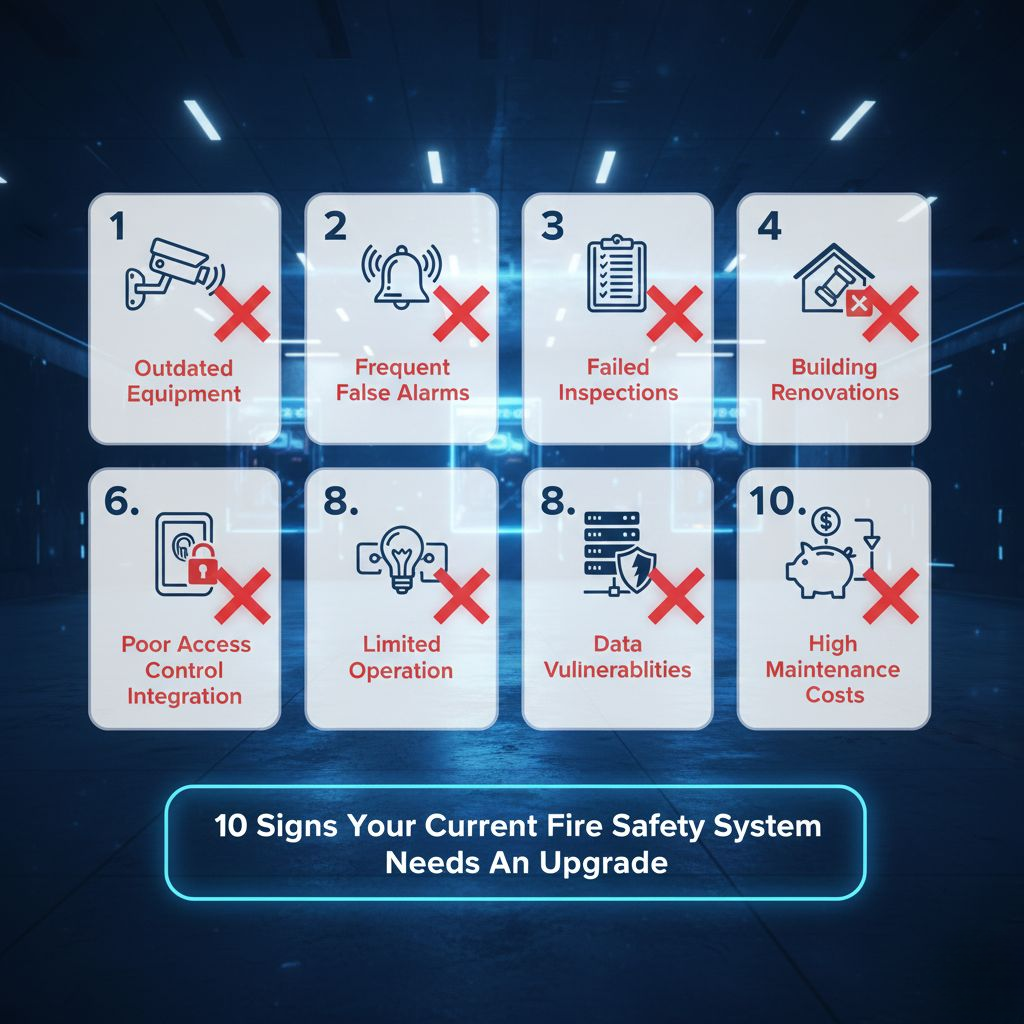
10 Signs Your Current Fire Safety System Needs an Upgrade Signs Your Current Fire Safety System Needs an Upgrade Industrial facilities, warehouses, corporate buildings, and manufacturing plants rely on fire safety systems to keep people, assets, and operations safe. But here’s the thing most businesses don’t admit: they treat their fire system like an old UPS battery. They install it once, forget about it, and hope it magically works forever. But fire safety is unforgiving. One missed upgrade, one old wire, or one neglected alarm panel is enough to turn a manageable spark into a disaster capable of shutting down operations for months. With rising compliance standards, high-value machinery, and stricter audits, businesses can’t afford outdated systems anymore. If you run or manage an industrial facility and aren’t sure whether your system is still reliable, here are the signs that your fire safety setup is overdue for an upgrade. 1. Your Fire Safety System Is More Than 8–10 Years Old Technology moves fast, and fire protection technology moves even faster. A system installed a decade ago might have been great back then, but today, it’s practically a fossil. Old panels and detectors lack the features modern industries need, such as: Addressable panels for pinpoint detection IoT-based monitoring Real-time alerts Integration with BMS and security systems Compatibility with new compliance standards The older the system, the more likely it is running on outdated wiring, unsupported components, and obsolete programming. In industries where electrical load, heat, and environmental stress are high, old systems degrade faster than you think. Industrial operations evolve too. You add new machinery, shift layouts, build new storage areas, expand workstations. If your fire safety system hasn’t evolved with your facility, you’re basically running new risks with old protection. 2. Your System Triggers Frequent False Alarms False alarms are the fire safety version of crying wolf. They happen so often in old or poorly installed systems that people stop taking them seriously. False alarms happen due to: Dust-clogged sensors (common in manufacturing units) Improper sensitivity calibration Decaying detectors Loose or damaged wiring Unprofessional previous installation Improper zoning Every false alarm stops work, wastes time, triggers evacuations, and causes production delays. But the real danger is psychological: employees get desensitized. So when a real fire happens, reaction time is slower. If your system keeps randomly screaming for no reason, it isn’t “overly sensitive.” It’s failing. 3. Outdated or Non-Compliant Wiring This is a massive problem in older Indian factories and commercial buildings. Many fire systems still use: Cheap PVC wires Low-grade copper cables Old conduits that crack under heat Loops improperly joined using electrical tape Zero fire-rated cable pathways This is not a small issue. Wiring is the nervous system of your fire detection setup. If the wire burns before the detector signals, the system literally dies before raising an alarm. Poor wiring also leads to: Short circuits Signal loss Zone failures Detector malfunction Panel errors Any facility with old wiring, messy routing, and non-compliant installations is sitting on a time bomb. Fire-rated FRLS cables, proper looping, certified junction boxes, and structured wiring aren’t optional. They’re mandatory. 4. Damaged, Missing, or Unmaintained Components Walk around your facility and do a quick visual audit. If you spot any of these, the system is begging for an upgrade: Detectors painted over during renovations MCPs (manual call points) that don’t press properly Sprinkler heads rusty or blocked Fire extinguishers with expired tags Sirens that sound weak or distorted Panels constantly displaying “Fault,” “Trouble,” or “Communication Error” Batteries swollen inside the panel Industrial environments speed up wear and tear. Heat, humidity, dust, vibration, chemicals, and mechanical activity all degrade fire safety equipment. If components are missing or damaged, the system will not respond during an emergency. This is the kind of failure that leads to major business loss. 5. Slow or No Response During Testing A fire safety system that doesn’t respond instantly is practically useless. When testing reveals problems like: Detectors taking too long to trigger Sirens activating only in some zones Panels freezing or lagging Delayed communication to control room Sprinklers failing to discharge during simulated tests it means the internal circuits are weak or outdated. Industries with boilers, generators, heavy machinery, and high electrical load stress the system even more. Heat and vibration alone can slowly destroy panel boards and connectors. When your system can’t perform during testing, expecting it to work in a real fire is wishful thinking. 6. Your Fire Audit Reports Are Getting Too Many “Recommendations” Let’s be honest: every audit gives recommendations, but when the list starts reading like a grocery list, there’s a real problem. Common audit issues that indicate you need an upgrade: No recent maintenance records Uncalibrated detectors Poor zoning Inadequate coverage in critical areas Wiring not as per IS/IEC standards Missing integration between alarms and hydrants Outdated fire extinguishers Zero system redundancy When the audit officer is telling you the same issues every year, they aren’t “recommendations” anymore. They’re warnings. 7. Your Facility Has Expanded But Your Fire System Hasn’t This is one of the biggest and most overlooked issues in growing companies. Factories expand very quietly: New production lines get installed Storage racks move Raw material stock increases Additional generators or compressors come in Floor plans shift More employees start working But the fire safety system stays frozen in the past. Expansion without upgrading means: New areas have no detection Sprinkler coverage is incomplete Emergency exits don’t match new layouts Evacuation capacity is outdated Power load increases but fire safety system wiring does not It’s like upgrading your entire building except the part that actually saves lives. 8. Your Insurance Company Is Asking Too Many Questions Insurance companies are not sentimental. If your system is outdated, they either charge higher premiums or reject claims after an incident. They usually ask for: AMC reports Testing logs Panel maintenance records Detector calibration reports Compliance certificates Layout drawings Photographic evidence If you can’t provide updated documents or if your system is old and non-compliant,

Fire Hydrant System vs Sprinkler System vs Gas Suppression:Which One Do You Need?
Fire Hydrant System vs Sprinkler System vs Gas Suppression: Which One Do You Need? Fire Hydrant System vs Sprinkler System vs Gas Suppression: Which One Do You Need? Choosing the right fire protection system isn’t about picking the most expensive or the most popular one. Each system — Fire Hydrant, Sprinkler, and Gas Suppression — works differently and is meant for different risks. The problem is, most buildings mix up what they actually need, which leads to poor protection or unnecessary expenses. This guide simplifies everything, giving decision makers a clear understanding using a hybrid structure: strong explanatory paragraphs plus sharp bullet points for quick comparison. Fire Hydrant System A fire hydrant system is built for large-scale firefighting. It relies on trained personnel who manually operate hoses and nozzles connected to hydrant outlets. This system is common in industries and warehouses because these places have high fire load and open spaces that need strong water discharge. Where It Works Best Industries and factories Warehouses and logistics spaces Large commercial compounds High-rise buildings Chemical storage zones (water-compatible) Advantages Handles big fires Covers long distances Strong water pressure Works even if power fails Limitations Needs trained staff Slower response time Heavy water damage Sprinkler System A sprinkler system activates automatically when heat reaches a set temperature. It only discharges water from the sprinkler head closest to the fire, making it efficient in early suppression. Sprinklers are widely used because they offer a perfect balance between cost, compliance, and quick response. Where It Works Best Offices and commercial buildings Malls, hotels, hospitals Residential apartments Parking areas Retail spaces Advantages Fast automatic action Localised water release Prevents major spread Proven high survival and protection rates Limitations Not suitable for server rooms Water-sensitive equipment can get damaged Gas Suppression System Gas suppression systems are for environments where water should NEVER be used. They use clean agents like FM200, NOVEC 1230, CO₂, or inert gas to extinguish fire instantly. The system activates automatically on detecting smoke or heat. It is the fastest and safest option for data-heavy rooms. Where It Works Best Data centres Server rooms UPS & electrical rooms Control panels Medical equipment rooms Archive and document storage Advantages Zero water damage Fastest suppression Equipment-safe No residue Minimum downtime Limitations Higher cost Requires room sealing Needs specialised maintenance Fire Load Handling Different buildings have different fire loads. Heavy fire loads demand strong water streams. Structured commercial spaces need early control. High-value electrical rooms need waterless protection. Matching fire load to the right system is essential for safety and cost control. System Suitability Hydrant: High fire load, large fires Sprinkler: Controlled commercial fires Gas Suppression: Electrical and electronic fires Damage Risk The type of damage caused by suppression is a major factor. Water-based systems can save a building but destroy equipment. Gas systems prevent both fire and water damage, making them ideal for sensitive spaces. Risk Levels Hydrant: Heavy water damage Sprinkler: Medium, controlled damage Gas Suppression: Zero water damage Cost & Installation Costs vary depending on system complexity. Hydrant and sprinkler systems require tank and pump room setups. Gas suppression systems require sealed rooms and gas cylinders, making them pricier but essential for critical rooms. Cost Overview Hydrant: Medium–High Sprinkler: Medium Gas Suppression: High Maintenance Requirements Maintenance determines long-term reliability. Hydrant and sprinkler systems require routine mechanical checks. Gas suppression systems require both mechanical and electronic maintenance, including room integrity tests. Maintenance Load Hydrant: Pump & hose checks Sprinkler: Valves & pressure tests Gas Suppression: Cylinder checks & integrity tests Business Continuity Impactre After a fire incident, downtime equals money lost. Hydrant systems cause the most downtime due to water cleanup. Sprinklers reduce spread, limiting downtime. Gas suppression keeps operations running almost immediately. Downtime Levels Hydrant: High Sprinkler: Medium Gas Suppression: Very low Quick Comparison Table Feature Hydrant System Sprinkler System Gas Suppression Activation Manual Automatic Automatic Water Usage High Medium None Speed Slow Fast Very Fast Damage Risk High Medium None Cost Medium–High Medium High Ideal For Industries Commercial Spaces IT/Electrical Rooms How to Choose the Right System Choosing the right fire protection system starts with analysing the specific fire risks inside your building. Industrial spaces like factories, warehouses, and large production areas usually face high fire loads, open layouts, and materials that can fuel fast-spreading fires. These environments benefit most from fire hydrant systems because they deliver strong, high-pressure water streams that can reach long distances and control large flames. In contrast, commercial buildings such as offices, malls, hotels, hospitals, and residential towers depend on sprinkler systems, which activate automatically when heat rises and control fire before it spreads. Sprinklers offer the ideal balance of reliability, early suppression, and compliance for high-occupancy spaces where water damage is acceptable compared to fire damage. For areas containing sensitive equipment or critical operations, a gas suppression system becomes the clear choice. Rooms with servers, UPS units, electrical panels, medical machines, telecom racks, and essential data cannot tolerate water at all, which makes clean-agent systems essential. Gas suppression extinguishes fires within seconds, leaves zero residue, and keeps downtime to an absolute minimum. Most modern buildings require a mix of all three systems, assigning hydrants to industrial zones, sprinklers to commercial areas, and gas suppression to high-value rooms. The best selection always depends on fire load, asset sensitivity, operational continuity needs, and mandatory safety regulations. Why iPower Automation Is the Right Partner iPower Automation stands out because it delivers complete, end-to-end fire protection solutions that are engineered for real-world performance, not just paperwork. The team understands the differences between hydrant systems, sprinkler systems, and gas suppression systems, and designs each setup based on the building’s actual risk profile, fire load, and operational needs. Every project follows national safety standards, including IS codes, NBC guidelines, and Fire NOC requirements. From planning and system design to supply, installation, integration, testing, and commissioning, iPower ensures every step is handled with precision. Their engineers also specialise in combining multiple systems within the same facility so each area gets the right level

Explain integration of alarms, CCTV, access control, hydrants, sprinklers.
Explain integration of alarms, CCTV, access control, hydrants, sprinklers. Why Industries Need Integrated Fire & Security Systems (Not Standalone Devices) Industrial plants, factories, warehouses, and large commercial buildings operate in environments where a single minor incident can escalate into a disaster. With heavy machinery, chemical storage, electrical loads, and large worker populations, industrial risks aren’t theoretical—they’re daily realities. Yet many facilities still depend on scattered, standalone fire alarms, isolated CCTV setups, basic access control systems, and non-automated hydrant or sprinkler systems that barely interact with one another. This outdated approach creates blind spots, slows incident response, and increases operational risk. To keep people, property, and operations safe, industries are transitioning to Integrated Fire & Security Systems, where all safety components work together under one centralized ecosystem. This detailed blog explains why integrated systems are essential, how fire alarms, CCTV, access control, hydrants, and sprinklers work when connected, and why iPower Automation is the trusted partner for implementing them correctly. 1. The Downside of Standalone Safety Systems For years, most industries installed safety components individually. A fire alarm system here, CCTV cameras there, a few access control devices at some doors—that’s how traditional installations look. And yes, each component technically “works,” but only in isolation. The problem? Emergencies are not isolated. They require immediate cooperation between multiple systems. Here’s what goes wrong with standalone setups: 1.1 Slow Response Time If a fire alarm triggers, someone has to manually find the camera feed, confirm the threat, unlock emergency exits, notify the team, and activate pumps. This wastes critical seconds. 1.2 Zero System Communication The fire panel can’t talk to CCTVs. CCTVs can’t talk to access control systems. Access control can’t talk to hydrants or sprinklers. This creates delays during incidents. 1.3 Heavy Human Dependency When systems don’t communicate, everything depends on operators making the right decision under stress. Mistakes are common. 1.4 Multiple Vendors & Rising AMC Costs Different brands, different software, different panels, different technicians—it’s messy and expensive. 1.5 Poor Audit & Compliance Readiness Modern audits require digital logs and automatic reporting. Standalone systems cannot generate unified event history. Integrated systems solve all these limitations by forming a single coordinated network. 2. What Is an Integrated Fire & Security System? An integrated system is a centralized safety ecosystem where every device works as a part of a connected network. All alarms, sensors, pump controllers, cameras, access points, and communication systems send data to a unified dashboard. Instead of depending on people to link the dots, the system does it in seconds. The components connected include: Fire alarm system Smoke and heat detectors CCTV cameras NVR/command center Access control & biometric readers Public Address (PA) system Sprinkler system Hydrant pump controllers Gas suppression systems Emergency lighting Building Management System (BMS) This creates a 360-degree safety environment where every subsystem responds intelligently and automatically. 3. How Integration Works Between Fire Alarms, CCTV, Access Control, Hydrants, and Sprinklers This is the heart of the blog: how each system behaves when integrated. When connected under a unified platform, each system reacts instantly during emergencies, reducing manual dependency and enabling automated safety actions. Fire Alarm System Integration The fire alarm panel is the command brain. When a smoke detector or heat detector activates, the panel triggers automated responses: Cameras in the fire zone appear instantly on the control room screens. PA system announces evacuation alerts. Emergency exit doors unlock automatically. Sprinkler or hydrant pumps activate. Notifications go to supervisors, safety officers, and facility managers. Power to certain hazardous equipment can be cut off through BMS. This turns a simple fire alert into a coordinated safety sequence. CCTV System Integration CCTVs are more than surveillance tools when integrated. Here’s what happens during an incident: CCTVs auto-focus on the alarm-triggered location. Operators get instant visual confirmation. Thermal or AI-enabled cameras detect heat or unusual patterns. Recorded footage helps in incident investigation and insurance compliance. This reduces false alarms and helps teams respond faster. Access Control Integration Access control becomes a life-safety feature, not just a security tool. During emergencies: All exit doors open automatically. Restricted zones get locked to prevent accidental entry. Turnstiles shift to fail-safe mode. Attendance and movement logs help confirm evacuation. Access control ensures people move safely without bottlenecks or confusion. Hydrant System Integration A hydrant system becomes smarter and more responsive. Integrated hydrants: Automatically trigger pumps when a fire alarm activates. Provide live pressure and flow data in the control room. Send notifications if hydrant valves are opened (fire or misuse). Allow CCTV verification of hydrant usage. This ensures firefighting starts immediately without waiting for manual pump activation. Sprinkler System Integration Sprinklers are extremely effective, but integrated sprinklers are even better. Integrated sprinklers: Activate pumps faster. Show zone-wise sprinkler activation in the fire control room. Give real-time flow-switch status. Coordinate with alarms and access systems for safe evacuation. This speeds up fire suppression and prevents major loss. Faster Incident Response = Lower Damage The biggest benefit of integrated systems is speed. Fire doesn’t wait for human decisions. Smoke spreads faster than people can react, and industrial materials accelerate fire growth. Integrated systems reduce the detection-to-action time drastically: Standalone vs Integrated Response Example Incident Stage Standalone Systems Integrated Systems Detection Works normally Works normally Alert Response Slow & manual Automatic Camera Validation Operator hunts for feed Auto-display on screen Door Unlocking Manual Auto-unlocked Hydrant/Sprinkler Activation Manual Auto-activated PA Announcement Human-operated Automated Safety Team Alerts Phone calls Automatic alerts Time saved: 20–40 secondsIn industrial safety, that’s huge.Sometimes, lifesaving. 5. Centralized Monitoring Improves Control & Decision-Making Standalone systems scatter monitoring across multiple panels and rooms. Integrated systems consolidate everything in a single command center. The team can view: Live alarms Camera feeds Pump activity System health Access control logs Detector status Sprinkler flow data Hydrant pressure This allows faster decisions and reduces confusion during complex emergencies. Multi-building facilities or multi-site industries can even monitor all locations from a single control room. 6. Better Compliance With Fire & Safety Standards Industries must comply with: NBC (National Building

The Role of Early Detection in Preventing Industrial Fire Losses
The Role of Early Detection in Preventing Industrial Fire Losses The Role of Early Detection in Preventing Industrial Fire Losses Industrial environments are uniquely vulnerable to fire incidents due to high fire loads, dense machinery layouts, hazardous chemicals, electrical systems, and round-the-clock operations. A fire in a manufacturing plant, warehouse, chemical facility, or logistics hub can escalate in minutes, leading to catastrophic losses. In these settings, early detection is the single most effective tool for preventing large-scale industrial fire disasters. Industry studies show that facilities equipped with modern early detection systems experience 30% to 70% lower fire-related losses compared to those relying solely on manual monitoring or outdated detectors. Rapid alerts allow safety teams to respond before flames spread, protecting inventory, machinery, and human life. For plant heads, factory owners, EHS managers, operations directors, and business decision-makers, early detection isn’t a technical feature — it’s a direct safeguard for assets, workforce safety, compliance, and financial stability. This blog breaks down the importance of early detection, how fire spreads in industrial settings, the technologies involved, and how iPower Automation helps industries strengthen their fire protection strategy. Why Early Detection Is Critical for Industrial & Warehouse Environments 1. Industrial Fires Spread Rapidly — Every Minute Matters Factories and warehouses operate with materials and processes that accelerate fire growth, including: • High-voltage electrical panels • Hydraulic oils and lubricants • Solvent vapors • Packaging materials like cardboard and plastic • Automated machinery and motors • High-density storage racks • Heat-generating processes A typical industrial fire timeline looks like this: 0–2 Minutes (Ignition & Early Warning Phase) • Electrical faults begin smouldering • Overheated motors generate heat pockets • Cable insulation starts decomposition • Vapors accumulate near ignition sources Early detection technologies like aspirating smoke detection (ASD) can identify pre-smoke particles or temperature anomalies here — long before flames form. 3–5 Minutes (Rapid Growth Phase) • Combustibles ignite • Heat intensifies • Smoke becomes denser • Nearby equipment and materials begin absorbing heat Standard detectors usually activate in this window. But intervention becomes harder, and damage accelerates. 6–10 Minutes (Escalation Phase) • Fire spreads vertically and horizontally • Racks, conveyors, and stored materials ignite • Structural elements get involved • Smoke reduces visibility drastically Once a fire reaches this stage, suppression is difficult and damage is severe. This is why early detection — in the first 1–3 minutes — is critical for industrial environments. 2. Early Detection Reduces Production Downtime Downtime is one of the biggest costs of industrial fires. Even a small fire can halt: • Production lines • Packaging sections • Electrical rooms• Dispatch operations • Conveyor systems • Material handling zones Research across industrial sectors shows: Minor fire incidents: 0–8 hours downtime Moderate incidents: 1–7 days downtime Major fires: 10–60 days shutdown, depending on structural damage When early detection happens, most incidents remain confined and rarely cross into full shutdown territory. 3. Protects High-Value Machinery & Infrastructure Industrial machinery is expensive. Damage to: • Automation lines • CNC machines • Packaging conveyors • Industrial ovens • Electrical panels • Control units • Storage racks • PLC systems …can disrupt production and require high repair costs. When detection happens early, teams can: • Isolate power immediately • Shut down conveyors • Activate suppression quickly • Manage the situation before fire reaches critical assets This reduces both direct losses (equipment damage) and indirect losses (downtime). 4. Strengthens Worker Safety & Evacuation Factories and warehouses often run multiple shifts with hundreds of employees. In such environments, early detection: • Provides faster alarm activation • Minimizes smoke inhalation risks • Gives teams time to execute evacuation • Helps emergency responders access the site safely • Reduces panic by enabling controlled response Many industrial injuries occur due to delayed alarms, not flames. Early detection prevents this. 5. Supports Compliance With National & International Standards Industrial facilities must comply with fire safety standards such as: • NBC 2016 • IS 2189 • Factory Act fire requirements • Local fire department NOC norms • Insurance audit requirements • CFO (Chief Fire Officer) licensing rules • International best practices like those set by NFPA Early detection systems help facilities: • Pass compliance audits • Avoid penalties or shutdown orders • Maintain valid licenses • Receive risk approval from insurers Compliance becomes smoother and more predictable. 6. Reduces Fire-Related Insurance Costs Insurance providers evaluate risks based on: • Fire detection capabilities • Maintenance records • System age • Audit compliance • Risk zoning Facilities with strong early detection systems often benefit from: • Lower premiums • Fewer audit observations • Faster and smoother claim settlements • Higher risk ratings In contrast, missing or outdated detection systems lead to claim delays or rejections. Key Early Detection Technologies for Industrial Fire Safety 1. Photoelectric, Ionization & Multi-Sensor Smoke Detectors Modern industrial spaces use: Photoelectric Detectors Best for slow-smouldering fires in: • Offices • Control rooms • Packaging areas • Storage zones Ionization Detectors Effective for fast-flaming fires involving: • Paper • Cardboard • Dry materials • Flammable solids Multi-Sensor Detectors Combine multiple technologies to reduce false alarms and increase accuracy. Ideal for: • Mixed-risk environments • Large manufacturing floors • Logistics hubs 2. Heat Detectors Used where smoke detection is unreliable due to: • Dust • Steam • High humidity • Heat-intensive processes Perfect for: • Boiler rooms • Workshops • Kitchens • Heavy industrial processes 3. Aspirating Smoke Detection (ASD) ASD systems offer ultra-early detection by continuously sampling air through a network of pipes. Ideal for: • High-ceiling warehouses • Electrical control rooms • Server & automation rooms • Clean rooms • Conveyor tunnels • Large storage facilities ASD detects smoke before visible smoke forms, making it one of the most advanced detection systems available. 4. Flame Detectors Used in high-risk industrial zones such as: • Fuel handling areas • Chemical processing rooms • Furnace zones • Open-flame operations They detect UV/IR radiation and trigger alarms within milliseconds. 5. Gas Detection Systems Essential in industries handling: • Solvents • LPG/CNG

Common Fire Safety Mistakes Industries Make and How to AvoidThem
Break down NFPA or local compliance, documents, testing, and requirements. Annual Fire Safety Audit: What It Covers and Why It Matters For factories, warehouses, logistics hubs, and high-risk industrial environments, fire safety is not just about compliance — it is a critical operational priority. An Annual Fire Safety Audit ensures that your facility’s fire protection systems, emergency response procedures, documentation, equipment, and infrastructure meet national standards and international best practices from organizations such as NFPA. For business owners, plant heads, facility managers, and EHS teams, this audit acts as a structured evaluation of risk, preparedness, and regulatory compliance. In industries where downtime, property damage, or safety lapses can lead to massive financial and legal consequences, an annual audit is one of the most important safety actions of the year. iPower Automation provides comprehensive, standards-driven fire safety audits designed specifically for industrial and commercial environments. These audits help organizations stay compliant with Indian fire norms, maintain operational continuity, and protect workers and assets. What an Annual Fire Safety Audit Covers A professional audit follows a detailed, systematic framework. It assesses physical conditions, evaluates fire protection systems, verifies compliance with standards, examines documentation, and tests operational readiness. Compliance With NFPA and Local Fire Standards A key portion of the audit focuses on verifying adherence to national and international fire codes, including: NFPA Standards Many industrial clients follow the guidelines set by NFPA 10, NFPA 13, NFPA 25, and NFPA 72. These define installation, maintenance, spacing, and testing norms for fire detection and suppression systems. Indian Standards and Local Regulations In India, compliance is evaluated against: • NBC 2016 • IS 2189 (Fire alarm systems) • Factory Act rules • State fire department norms • Fire NOC guidelines for commercial and industrial establishments Failure to comply with these regulations can result in penalties, closure notices, or rejection of fire-related insurance claims. Review of Fire Safety Documentation Accurate, up-to-date documentation is essential during inspections. Key records verified during an audit include: • Fire extinguisher inspection logs • Fire alarm maintenance reports • Hydrant and sprinkler testing documents • Fire pump pressure records • Emergency lighting test reports • Evacuation drill registers • Electrical load & panel inspection reports • Fire NOC validity and renewal status • AMC documents from service providers • Fire load calculations iPower Automation ensures all documents meet statutory requirements and reflect actual on-site conditions. Testing of Fire Detection and Alarm Systems Auditors physically test each component of the fire detection network, including: Smoke and Heat Detectors Checks include: • Sensitivity testing • Detector placement accuracy • Response verification • Cable integrity • Battery backup • Panel fault logs • Manual call point functioning Incorrect placement or non-responsive detectors are major compliance failures in many facilities. Fire Alarm Control Panel Engineers check panel health, fault history, PA integration, and battery conditions. This ensures that alarms trigger correctly and communicate instantly throughout the facility. Firefighting Equipment Inspection Industrial facilities rely on several layers of firefighting infrastructure. An audit evaluates the following: Fire Extinguishers (All Types) Auditors verify: • Expiry • Pressure levels • Rust/corrosion • Proper class (A, B, C, K) • Wall mounting & accessibility • Missing or damaged pins, hoses, or brackets Expired or missing extinguishers are among the most common non-compliances. Hydrant System Inspection includes: • Pump status and performance • Hydrant pressure • Hose box condition • Valve positions • Water tank capacity • Flow testing results Sprinkler System Auditors check: • Coverage & spacing • Sprinkler head orientation • Obstructions • Pressure • Valve sealing Electrical Safety Assessment More than half of industrial fire incidents originate from electrical faults. An audit thoroughly inspects: • Exposed or loose wiring • Damaged insulation • Overloaded panels • Improper cabling near flammable materials • Temporary connections • Open junction boxes • Transformer & DG room safety iPower Automation provides detailed reports highlighting high-risk electrical zones. Structural & Housekeeping Fire Hazard Inspection A facility’s layout and housekeeping practices significantly affect fire risk. Auditors check for: • Blocked emergency exits • Materials stored near hot surfaces • Chemical storage non-compliance • Poor ventilation • Damaged fire doors • Cluttered passages • Inaccessible extinguishers or hydrants • Unsafe welding & cutting areas These practical hazards contribute directly to fire incidents and must be corrected immediately. Emergency Preparedness & Staff Readiness A fire safety system is only as strong as the people trained to use it. Auditors evaluate: • Frequency of fire drills • Worker awareness of evacuation routes • Assembly area clarity • First-aid training • Emergency communication system functioning • Response times of safety teams High-performing industrial facilities conduct multiple drills each year to ensure readiness. Fire Load Analysis & Risk Classification Facilities are classified into: • Low risk • Moderate risk • High risk (common in factories & large warehouses) Fire load calculations help determine: • Required number of detectors • Pump capacity • Extinguisher types • Need for sprinklers or suppression systems • Emergency lighting intensity This ensures the facility has the correct infrastructure for its risk category. Why an Annual Fire Safety Audit Matters for Industries 1. Prevents Fire Accidents Audits identify risks like faulty wiring, blocked exits, expired extinguishers, or non-functional detectors long before they cause incidents. 2. Ensures Legal & Regulatory Compliance Audits help industrial facilities stay compliant with NBC norms, IS codes, and local fire regulations, avoiding penalties or shutdowns. 3. Protects Employees and High-Value Assets Factories and warehouses contain machinery, inventory, raw materials, and combustible goods. A fire can cause multi-crore losses within minutes. 4. Maintains Insurance Validity Insurance companies require proof of regular maintenance. A fire safety audit strengthens claims and prevents rejection. 5. Reduces Downtime Timely corrections prevent production line stoppages caused by fire hazards or failed inspections. 6. Builds a Strong Safety Culture Regular audits influence worker behavior, improving discipline, safety awareness, and emergency coordination. Why iPower Automation Is the Right Partner for Industrial Fire Safety Audits iPower Automation delivers specialized Annual Fire Safety Audits for factories, warehouses, corporate buildings, malls,

How to Choose the Right Smoke Detector for Your Facility
How to Choose the Right Smoke Detector for Your Facility How to Choose the Right Smoke Detector for Your Facility Ensuring fire safety in any commercial or industrial facility begins with choosing the right smoke detector. A reliable system doesn’t just tick a compliance box; it offers early detection, protects life and property, and prevents small incidents from becoming catastrophic fires. With diverse technologies available, facility owners often struggle to decide which detector is best suited for their environment. That’s where expert guidance becomes essential. This comprehensive guide explains each type of smoke detector, compares ionization, photoelectric, multi-sensor, and heat detectors, and highlights how iPower Automation helps businesses choose and implement the most effective fire safety solutions. Why the Right Smoke Detector Matters A smoke detector is the heart of any fire alarm system. Early warning can drastically reduce damage, prevent downtime, and save lives. But an incorrect choice can lead to delayed detection, frequent false alarms, and non-compliance with fire safety standards such as NBC norms and IS 2189. Selecting the right device ensures accurate detection, stable performance, and seamless integration with your facility’s fire alarm system. iPower Automation specializes in designing fire safety solutions tailored to the unique layout and risk profile of every building. Types of Smoke Detectors You Can Choose From Understanding how each detector works is the first step toward making the right choice for your facility. 1. Ionization Smoke Detectors Ionization detectors are designed to detect fast-flaming fires, typically caused by paper, plastic, wood, or other easily combustible materials. How They Work A small amount of radioactive material ionizes air between two electrodes. When smoke enters the chamber, it interrupts this ionization process, triggering the alarm. Advantages • Quick response to flaming fires • Affordable technology • Widely used in storage-heavy facilities Limitations • Higher risk of false alarms in dusty or kitchen-adjacent environments • Less effective for smouldering fires • Not suitable for moisture-prone areas Best Applications • Warehouses • Electrical rooms • Storage spaces • Manufacturing areas with rapid ignition risks iPower Automation often recommends ionization smoke detectors where the fire load involves materials that ignite instantly, ensuring quick detection and rapid response. 2. Photoelectric Smoke Detectors Photoelectric detectors are the most popular choice for modern commercial buildings. They excel at detecting slow, smouldering fires that produce heavy smoke before bursting into flames. How They Work These detectors use a light source and sensor. When smoke enters the chamber, it scatters the light beam, causing the sensor to activate the alarm. Advantages • Highly effective for smouldering fires • Fewer false alarms than ionization detectors • Ideal for offices, hotels, and retail spaces Limitations • Slightly slower detection for fast-flame fires • Dust accumulation may affect long-term performance Best Applications • Office spaces • Corridors • Residential areas • Commercial establishments iPower Automation recommends photoelectric detectors for most commercial clients because they offer stable performance, high accuracy, and a lower risk of nuisance triggers. 3. Multi-Sensor Smoke Detectors Multi-sensor detectors combine two or more technologies (usually photoelectric + ionization, sometimes heat or CO sensors). They deliver high-precision detection across all fire types. How They Work Multiple sensors gather real-time data and use algorithms to determine if a fire event is occurring. This technology significantly reduces false alarms and increases reliability. Advantages • Rapid response for both smouldering and flaming fires • Lowest false alarm rates • Ideal for high-occupancy and high-value environments • Smart analysis reduces unnecessary evacuations Limitations • Higher cost compared to single-sensor options • Requires advanced system integration Best Applications • Shopping malls • Hospitals • Hotels • Corporate buildings • Mixed-use commercial facilities iPower Automation frequently installs multi-sensor systems in buildings with diverse occupancy and complex layouts, ensuring comprehensive coverage and dependable response times. 4. Heat Detectors Heat detectors are essential for environments where smoke detectors would give false alarms due to dust, humidity, or cooking fumes. How They Work Two types exist: • Fixed-temperature detectors activate at a set temperature. • Rate-of-rise detectors activate when temperature increases rapidly. Advantages • Immune to dust, steam, or smoke interference • Ideal for heavy-duty industrial spaces and kitchens • Low maintenance Limitations • Slower detection compared to smoke detectors • Not suitable as a primary life-safety measure in most areas Best Applications • Commercial kitchens • Boiler rooms • Industrial factories • Parking basements • Mechanical rooms iPower Automation deploys heat detectors where smoke-based detection is impractical, ensuring precision and avoiding unnecessary disruptions. Comparison: Ionization vs Photoelectric vs Multi-Sensor vs Heat Detectors Choosing the right smoke detector for your facility requires understanding how each technology performs in real conditions. Detection Speed • Ionization: Very fast for open flames • Photoelectric: Best for smouldering fires • Multi-Sensor: Fastest overall • Heat Detectors: Slowest, suitable for harsh environments only False Alarm Resistance • Heat Detectors: Most stable • Photoelectric: Low false alarms • Multi-Sensor: Extremely low false alarms • Ionization: More prone to false triggers Ideal Fire Types • Ionization: Paper, packaging, and sudden flaming fires • Photoelectric: Smouldering fabric, foam, or electrical fires • Multi-Sensor: All fire types • Heat: High heat or cooking-based fire hazards Cost • Ionization: Low • Photoelectric: Moderate • Multi-Sensor: High • Heat Detectors: Moderate Recommended Environments • Ionization: Storage areas, material-heavy facilities • Photoelectric: Offices, hotels, retail stores • Multi-Sensor: Hospitals, malls, high-rise buildings • Heat Detectors: Kitchens, basements, workshops How to Select the Right Smoke Detector for Your Facility 1. Evaluate Fire Risks Before choosing a smoke detector, identify what type of fire threat is most likely. • High fire load with materials: ionization or multi-sensor • Slow smouldering risk: photoelectric • Harsh environment: heat detector iPower Automation performs on-site fire risk assessments to determine the ideal detector type. 2. Consider the Facility Layout Large spaces, high ceilings, and open areas require different detection strategies compared to small, partitioned rooms. • Warehouses may require aspirating smoke detection (ASD) • Office floors work best with photoelectric or multi-sensor units • Server rooms need ultra-sensitive

The Complete Guide to Fire Alarm Systems for Commercial Buildings
The Complete Guide to Fire Alarm Systems for Commercial Buildings The Complete Guide to Fire Alarm Systems Fire safety is one of the most vital aspects of commercial building management. Every year, thousands of fire incidents occur in offices, malls, hospitals, warehouses, manufacturing units, and commercial complexes across India due to electrical faults, poor wiring, overheating equipment, and improper maintenance practices. A fire alarm system acts as the first line of defense by detecting early fire signs, alerting occupants, triggering evacuation, and coordinating with other emergency systems. Commercial buildings are particularly vulnerable because they contain large numbers of people, expensive equipment, critical documents, server rooms, and flammable materials. A reliable fire alarm system ensures early identification of threats and prevents them from escalating into major disasters. iPower Automation, a leading fire safety solutions provider in Bangalore, offers complete fire alarm system services including design, installation, programming, testing, commissioning, integration, and annual maintenance. Their engineering-driven approach ensures that fire alarm systems are installed with technical accuracy and complete compliance with NBC and BIS guidelines. What Is a Fire Alarm System? A fire alarm system is a network of electrical devices installed throughout a building to detect fire early and alert occupants through audio-visual signals. These systems include detectors (smoke/heat), manual call points, sirens, control panels, wiring or networking modules, and emergency communication units. A fire alarm system performs three primary functions: 1.Detect fire or smoke. 2.Alert building occupants. 3.Communicate with emergency services or suppression systems iPower Automation designs fire alarm systems tailored to the specific needs of commercial buildings, ensuring precise coverage and correct technical integration. Why Fire Alarm Systems Are Mandatory for Commercial Buildings Fire alarm installation isn’t optional. It is legally required under: National Building Code (NBC) of India Bureau of Indian Standards (BIS) Local Fire Department Regulations Factory Act & Labour Safety Standards Insurance Company Requirements Key Reasons 1. Early Life Safety Most fire-related deaths occur due to smoke inhalation and delayed evacuation. A fire alarm system reduces response time. 2. Property Protection Early detection stops fires before they spread to critical assets like servers, inventory, machinery, or documents. 3. Legal Compliance Authorities will not issue Fire NOC or Occupancy Certificate unless fire alarms are installed and certified. 4. Insurance Approvals Insurance companies require functioning alarm systems to approve claims. 5. Business Continuity Fire incidents lead to downtime. Alarm systems protect operations from extended losses. Types of Fire Alarm Systems Fire alarm systems mainly come in three categories. Selecting the right one depends on building size, risk level, and compliance needs. A. Conventional Fire Alarm System A conventional fire alarm system divides the building into separate zones. Each zone has multiple detectors and devices connected to the control panel through dedicated wiring. How It Works When a detector is triggered, the panel shows the affected zone. Advantages Cost-effective Easy installation Suitable for small buildings Disadvantages Does not show the exact detector Requires more wiring Best For Small offices, shops, small hotels, godowns, and low-rise buildings. B. Addressable Fire Alarm System An addressable fire alarm system assigns a unique digital address to each device. The panel receives updates from every detector in real-time. How It Works When triggered, the panel displays the exact location and device ID. Advantages Highly accurate Less wiring Lower long-term maintenance Device-level monitoring Disadvantages Higher initial cost Best For Large offices, malls, hospitals, industries, tech parks, commercial complexes. iPower Automation specializes in addressable systems for mid- and large-scale commercial buildings. C. Wireless Fire Alarm System Wireless fire alarm systems use radio frequency communication instead of cabling. Advantages Fast installation No wiring visible Ideal for finished interiors Disadvantages Expensive Battery replacements required Best For Hotels, renovation projects, heritage buildings, luxury interiors. Types of Fire Detection Devices A. Smoke Detectors Photoelectric detectors Ionization detectors Multi-sensor detectors B. Heat Detectors Rate-of-rise Fixed temperature C. Manual Call Points Break-glass units installed at exits for manual activation. D. Sounders & Strobe Lights Audible and visual alarms. E. Beam Detectors For large halls and atriums. F. Gas and CO Detectors For kitchens, basements, and generator rooms. How a Fire Alarm System Works 1. Detection Smoke, heat, or gas triggers a detector. 2. Communication Signal is sent to the fire alarm control panel. 3. Panel Analysis Panel verifies alarm or fault. 4. Alert Activation Sounders, strobes, and emergency notifications activate. 5. System Integrations This may include: Sprinkler activation Elevator recall HVAC shutdown BMS alerts iPower Automation integrates fire alarm systems with CCTV, access control, PA systems, and BMS. Key Components of a Fire Alarm System Fire Alarm Control Panel Smoke and heat detectors Beam detectors Gas detectors Manual call points Sounders and strobes Repeater panels Power supply modules Fire-rated cables Backup batteries Loop isolators Relay modules iPower Automation uses only BIS-certified components. Installation Best Practices Key practices: Follow IS 2189 and NBC guidelines Correct detector spacing Avoid placing detectors near AC vents or exhausts Use fire-rated cables in metallic conduits Conduct loop continuity tests Ensure address verification Provide redundancy for critical circuits iPower Automation follows a structured installation checklist to ensure maximum reliability. Maintenance Requirements Fire alarms require continuous testing and upkeep. Monthly Test MCPs Test sounders Check battery voltage Quarterly Clean detectors Test wiring integrity Annually Full system testing Load testing on batteries Device recalibration iPower Automation provides AMC services including detailed test reports, logs, device history, and maintenance records. Benefits of Modern Fire Alarm Systems Faster response Lower property damage Automated emergency actions Remote monitoring Reduced false alarms Higher tenant and employee safety Choosing the Right Fire Alarm System Small structures → Conventional Medium/Large buildings → Addressable Premium interiors → Wireless iPower Automation conducts detailed site surveys to determine the best system for any commercial property. Why iPower Automation Is the Right Partner for Your Fire Alarm System Needs iPower Automation is the ideal partner for commercial fire alarm system projects because it delivers complete end-to-end solutions backed by engineering accuracy, certified components, and strong compliance support. The company manages site surveys, system design, and device selection with a

“Fire Safety Systems Healthcare: Essential Regulatory Requirements for Hospitals”
Fire Safety Systems Healthcare: Essential Regulatory Requirements for Hospitals Regulatory Requirements for Fire Safety Systems in Healthcare Ensuring robust fire safety systems healthcare is critical for every hospital, clinic and medical facility. Patients often cannot evacuate on their own, and the mix of medical gases, circuitry, flammable materials and complex zones raises the stakes. A comprehensive framework combines national standards, international best practices, state-level norms, zone-specific guidelines and a dedicated compliance owner. NABH / Indian Standards Overview In India, healthcare facilities seeking accreditation or licences must comply with national safety and quality standards. These include detailed expectations for fire protection, evacuation planning, structural fire safety, fire-fighting equipment and maintenance procedures. A healthcare facility must design fire-resistant compartments, allow proper means of escape, install automatic detection and suppression systems and maintain logs of drills, inspections and maintenance. The mandate is that every functional zone — from wards to laboratories — integrates fire safety into daily operations. Embedding fire safety systems healthcare at this stage means linking design, equipment, training and monitoring into a unified approach. NFPA References Although Indian standards are mandatory, many forward-looking healthcare organisations reference international codes because they address advanced scenarios, high-risk zones and redundancy. These guidelines cover issues such as egress for incapacitated patients, backup power for fire-alarms, specialised suppression for oxygen-rich zones and hazard classification for complex spaces. By aligning with such global benchmarks, facilities enhance their internal safety architecture and strengthen their fire safety systems healthcare. Karnataka State Norms + Fire NOC At the state level (such as Karnataka), healthcare establishments must obtain a Fire No-Objection Certificate (NOC) issued by fire services authorities. This involves submitting building plans showing fire-fighting layout, means of escape, occupancy classification and fire-safety compliance. Hospitals must renew the certificate periodically and retain proof of compliance. Without this clearance, licensing and operational permissions can be withheld. Therefore, for effective fire safety systems healthcare, state-level clearance is a non-negotiable checkpoint. Fire Safety Guidelines for Specific Zones Healthcare facilities consist of multiple zones with distinct fire-safety demands. Applying tailored guidelines for each zone ensures that the overarching fire safety systems healthcare strategy is truly comprehensive. In-patient Wards In-patient wards house patients who may have limited mobility. Exit routes must be wide, unobstructed and clearly marked. Emergency lighting needs to function during power failures, smoke detection and sprinklers should protect corridors, doors and walls must meet fire-rating standards, and staff must be trained to manage rapid evacuation of bed-ridden patients safely. ICU (Intensive Care Unit) The ICU is a high-risk area: advanced life support equipment, restricted mobility and heightened staffing needs. Fire-safety systems here require redundant power for alarms and lighting, uninterrupted monitoring, and smoke control systems that prevent fire or smoke from spreading into critical zones. Doors should swing clear and evacuation plans must accommodate stretchers and beds. Integration with medical gas shut-off systems enhances safety in these high-risk environments. OT (Operating Theatre) Operating theatres are unique because they contain sterile environments, medical-gas lines, high-value equipment and active procedures in progress. Fire-safety systems must include suppression technologies suited for gas and electrical hazards (not just water sprinklers), strict access control, minimal combustible materials, and coordination with HVAC to prevent smoke from interfering with surgical setups. A failure in this zone can jeopardise both patient and procedural safety. Labs (Laboratories) Labs in healthcare facilities handle chemicals, electrical systems, specimens and sometimes flammable gases. Fire-safety systems for labs must include explosion relief mechanisms, chemical-fire suppression agents, dedicated ventilation, leak-detection sensors and compartmentation to isolate fire risk. Controlled access, staff training in lab-specific fire response and routine drills are essential. Pharmacy Pharmacies store medicines, some of which are flammable or volatile. The area requires fire-rated storage rooms, control over ignition sources, automatic fire detection, alert systems for temperature rise and specialised suppression for fires involving chemicals. For fire safety systems healthcare, the pharmacy zone must be treated as a high-risk storage space with tailored suppression, alarms and training in safe handling of flammables. Medical Gas Storage Medical-gas storage rooms (oxygen, nitrous oxide, compressed air) present significant fire risk because of enriched‐oxygen atmospheres and high-pressure cylinders. Fire-safety systems must include oxygen-compatible suppression (water alone may be inadequate), fire-rated enclosures, gas-leak detection, immediate shut-off valves linked to fire-alarms and dedicated evacuation routes. Given the critical nature of this zone, it is one of the strongest tests of a facility’s overall fire-safety architecture. Compliance Officer Responsibilities A dedicated Compliance Officer oversees the fire-safety programme and ensures the integrity of the fire safety systems healthcare framework. Key responsibilities include: Ensuring the facility holds valid fire-NOC certificates and structural/fire‐safety clearances, and managing timely renewals. Conducting periodic fire-risk assessments across all zones, analysing vulnerabilities (e.g., crowded wards, old wiring, gas-leaks) and implementing corrective action plans. Scheduling and documenting fire drills, evacuation rehearsals, equipment inspections, maintenance of detection/suppression systems and training for staff in every zone. Liaising with state fire services for inspections, ensuring building plans remain consistent with changes (expansions or refurbishments) and coordinating external audits. Maintaining records: logs of testing, inspections, fire-fighting equipment maintenance, staff training, incident reports and response times. Ensuring integration of fire-safety systems with building automation, access control and surveillance systems to enable seamless incident response rather than siloed reactions. Why This Framework Matters When all these pieces come together — national standards, state norms, zone-specific guidelines and a proactive compliance structure — the result is not just a tick-box exercise. It becomes a resilient facility where fire safety systems healthcare operate at a level that protects lives, supports uninterrupted care and fosters trust with patients and staff alike. Skipping any one of these domains creates risk: structural weaknesses, slow response in critical zones, regulatory non-compliance or even closure of facility services. Frequently Asked Questions – Fire Safety Systems Healthcare What are “fire safety systems healthcare” and why do hospitals need them? These are integrated systems—access control, alarms, sprinklers, suppression and evacuation protocols—built for healthcare settings where patients can’t always self-evacuate and medical hazards are present. What does a healthcare facility need to check for regulatory fire-safety